
Modular Homes in Los Angeles: What Everyone in the Room Is Really Thinking


Factory precision sounds great. Field reality is where the truth shows up.
Say “modular” in a Los Angeles rebuild meeting and watch the room split.
The homeowner hears speed.
The architect hears constraints.
The builder hears foundation tolerances, crane access, waterproofing joints, and warranty exposure.
The structural engineer hears load paths, lateral connections, seismic movement, and anchorage.
The subcontractor hears scope gaps.
Everyone is talking about the same construction method.
No one is hearing the same thing.
That is why the modular construction conversation in Los Angeles needs to get more honest.
Modular and off-site construction may become a major part of the future of homebuilding in Los Angeles. The pressure is real: wildfire rebuilds, labor shortages, rising construction costs, long schedules, insurance uncertainty, and homeowners who want more predictability from a process that has historically offered very little.
But high-end custom homes are not simple products moving down an assembly line. They are site-specific, design-intensive, owner-driven, regulation-heavy, and performance-sensitive.
Moving more work into a factory can reduce some risks. It can also concentrate other risks in places that are harder to see until it is too late.
The factory can control the assembly.
The team still has to control the building.
Off-Site Construction Is Not One Thing
Before getting into the debate, it helps to define the terms.
Off-site construction can mean many things:
panelized wall systems
floor cassettes
roof trusses
bathroom pods
prefabricated MEP racks
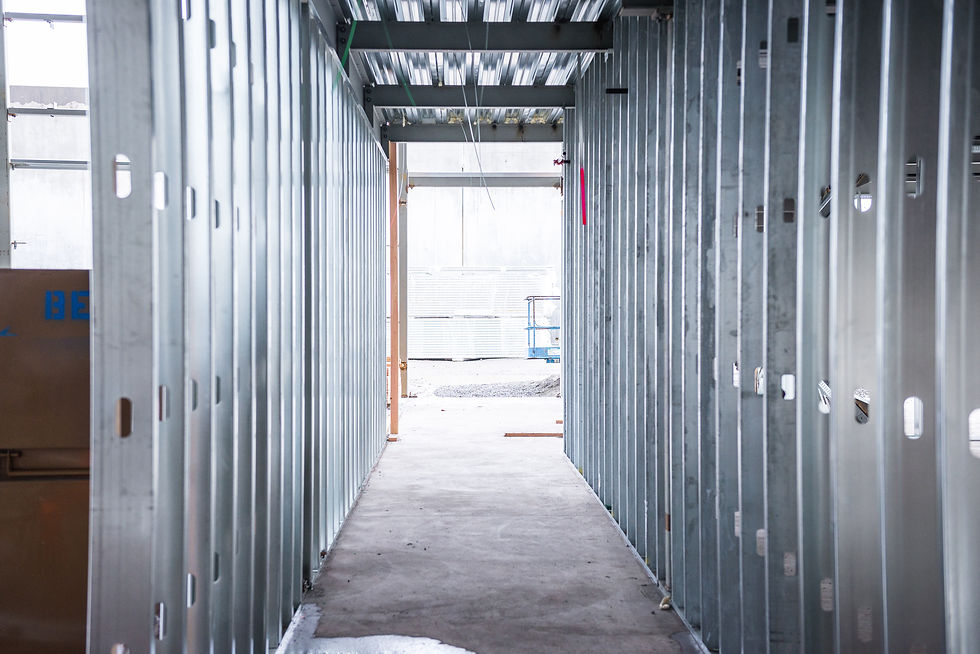
light-gauge steel assemblies
shop-built millwork
volumetric modular units
hybrid combinations of factory-built and site-built work
The Whole Building Design Guide describes off-site construction as the planning, design, fabrication, transportation, and assembly of building elements away from the final building site for rapid assembly on site. Volumetric modular is one of the most complete versions, where three-dimensional units may arrive with a significant portion of the factory finish already complete.
That distinction matters.
A panelized wall system is not the same as a nearly complete turnkey modular home. A bathroom pod is not the same as a full volumetric building system. A hybrid approach is not a watered-down version of modular. In many custom-home situations, it may be the smarter version.
McKinsey’s modular construction research specifically notes that capturing the full benefits of modular construction requires solving for materials, logistics, assembly, manufacturing, repeatability, and the right mix of 2D panels, 3D modules, and hybrid designs.
That supports a more mature question:
Not “Should this home be modular? ”But “Which parts of this home should be built off site, and which parts need to stay under direct field control?”
That is the real conversation.
The Promise: Build Faster, With Fewer Surprises
The sales pitch is simple:
Build more of the home in a factory. Prepare the site at the same time. Reduce field chaos. Compress the schedule. Improve quality control. Deliver faster.
That promise is not imaginary.
Factory-built systems can reduce weather exposure, improve material protection, increase repeatability, and allow certain scopes to progress while site work is underway. McKinsey frames modular construction as a way to shift construction activity away from traditional jobsites and into manufacturing-style production, with the potential to improve productivity in an industry that has historically lagged behind other sectors.
But the promise is conditional.
Modular works best when the project has enough repetition, early decision-making, and system clarity to support the factory process.
High-end custom homes often move in the opposite direction.
They involve evolving client preferences, bespoke architecture, unique sites, complex assemblies, demanding finish tolerances, specialty consultants, and late-stage refinements.
That does not mean off-site construction cannot work.
It means the team needs to know exactly where it works and where it starts to fight the project.
What everyone at the table is thinking
The homeowner
“If this gets me home faster and protects me from overruns, I’m interested. But I do not want to feel like I bought a shortcut.”
The architect
“I like the efficiency, but I do not want the manufacturing system to flatten the architecture.”
The structural engineer
“Show me the system, the connections, the load path, and the tolerances before everyone starts promising speed.”
The builder
“Parallel schedules only work if both schedules are real.”
The subcontractor
“Tell me where my scope starts, where it stops, and who owns the tie-in.”
The brutal truth
Speed is not the same as control.
A compressed schedule with unresolved site conditions, unclear scopes, poor inspection planning, or incomplete design decisions is not innovation.
It is just a faster failure window.
Modular Homes Los Angeles: The First Reality Check

In conventional custom-home construction, late decisions are painful.
In modular construction, late decisions can attack the production system itself.
That is one of the biggest differences.
The AIA/NIBS modular and off-site construction guide emphasizes that early design decisions are especially important in modular construction because they improve coordination between stakeholders and help reduce project costs.
That is the polite industry version.
The builder version is simpler:
The factory does not forgive indecision.
Once fabrication starts, a change is no longer isolated. A window change may affect structural openings, waterproofing, shop drawings, energy compliance, exterior cladding, interior trim, procurement, schedule, and inspection sequencing.
That is why a true modular process needs a real design freeze.
Not a casual one.
A real one.
Before fabrication begins, the team needs to resolve:
structural system
lateral load path
MEP coordination
window and door package
exterior wall assemblies
roof assemblies
waterproofing transitions
utility tie-ins
appliance selections
lighting layouts
low-voltage strategy
finish direction
owner selections
foundation interface
crane and delivery strategy
site access
inspection responsibility
warranty responsibility
If those items are not resolved, the project is not ready for fabrication.
It may be ready for optimism.
But optimism is not a construction strategy.
What everyone at the table is thinking
The homeowner
“Wait, I have to make decisions earlier than I expected?”
Yes.
That is the tradeoff.
If the homeowner wants factory speed, the homeowner also needs to accept earlier decision discipline.
The architect
“I need enough room to develop the design properly before the system locks us in.”
Correct.
The design process cannot be artificially rushed into production before the architecture is resolved.
The structural engineer
“Do not release fabrication drawings until the structural assumptions are locked.”
Exactly.
Load paths, connection details, anchorage, tolerances, and movement strategy must be coordinated before production.
The builder
“Who has authority to say no after the release package is approved?”
This is one of the most important questions.
If no one can enforce the design freeze, the schedule and cost model are fragile.
The subcontractor
“Do not give me a factory-built condition and then ask me to make a late change look invisible.”
That is fair.
The brutal truth
Full turnkey modular requires a more disciplined client and design process than many luxury residential projects are used to.
If the owner, architect, builder, and manufacturer are not aligned before fabrication, the factory can become an expensive place to discover unresolved decisions.
The Moment the Factory Meets the Dirt

A factory is controlled.
A Los Angeles jobsite is not.
That is where the next reality check begins.
California’s Department of Housing and Community Development regulates factory-built housing and factory-built housing components manufactured for sale in California. But that does not mean the local building department disappears. HCD’s own factory-built housing materials explain that local agencies remain involved in assembly, installation, post-installation alterations, and code enforcement.
The HCD local enforcement handbook states that factory-built housing units must be assembled on site according to approved installation instructions, and that the local building department, not HCD, is responsible for inspecting the assembly and installation of factory-built housing units.
LA County’s factory-built housing guidance for single-family rebuilds makes the split even clearer: local building departments are responsible for permit and plan review for portions not designated as factory-built housing or not previously approved by HCD, including site work and utility connections. The local agency then inspects assembly and installation at the site.
Translation:
Modular does not remove the site.
It makes site readiness more important.
A factory-built home still has to deal with:
demolition
debris removal
grading
soils
drainage
retaining walls
foundations
utility connections
street access
crane access
staging
neighbor constraints
local inspections
site-built transitions
final finish integration
And in Los Angeles, those are rarely simple.
What everyone at the table is thinking
The homeowner
“I thought the factory solved most of the construction risk.”
Not exactly.
The factory may solve some production risk. It does not solve site risk.
The architect
“The home still has to respond to slope, views, access, privacy, setbacks, orientation, and neighborhood context.”
Correct.
The site still leads.
A building system that ignores the site is not a building system. It is a product looking for a place to land.
The structural engineer
“The foundation needs to be right before the building arrives.”
This is not optional.
For modular or heavily prefabricated systems, foundation tolerances become unforgiving. Dimensions, elevations, bearing points, anchor locations, embeds, hold-downs, utility stubs, and lateral connection points need to be verified before delivery.
A small miss can become a large set-day problem.
The builder
“Is the site actually ready, or are we pretending it is ready because the factory is on schedule?”
That is the question that protects the project.
The factory schedule is only useful if the site schedule is real.
The subcontractor
“If the site is almost ready, it is not ready.”
Exactly.
Almost ready is how field improvisation starts.
The brutal truth
Off-site construction makes site readiness more important, not less.
If the foundation is wrong, the utilities miss, the crane cannot stage, or the inspections are not aligned, the factory’s precision does not save the project.
It exposes the site’s lack of precision.
The Moment Water Finds the Joint

This is where the building science conversation starts.
Factory-built assemblies can be excellent. Materials can be protected from weather. Repetitive details can be refined. Work can be inspected before shipment. Labor can operate in a controlled environment.
But building performance is not determined by the module alone.
It is determined by the continuity of the system after installation.
Building Science Corporation’s “Perfect Wall” framework identifies the water control layer, air control layer, vapor control layer, and thermal control layer as fundamental to enclosure performance.
That principle is brutally relevant to modular construction.
The question is not just whether the wall was built well in the factory.
The question is whether the water, air, vapor, and thermal control layers remain continuous after the factory-built work meets the site-built work.
The risk lives at the interfaces:
module-to-module joints
foundation-to-wall transitions
roof-to-wall transitions
deck-to-wall transitions
balcony interfaces
window and door openings
utility penetrations
mechanical penetrations
electrical penetrations
plumbing penetrations
site-built cladding transitions
parapets
roof penetrations
garages
basements
retaining walls
pools and hardscape
That is where water gets in.
That is where air leaks happen.
That is where firestopping can be missed.
That is where trades argue over responsibility.
A module can be perfectly built and still become part of a poor building if the control layers are not continuous after installation.
What everyone at the table is thinking
The homeowner
“I do not care where the wall was built if it leaks.”
Correct.
The homeowner bought confidence, not a manufacturing story.
The architect
“The detail looks clean on paper, but can it actually be sequenced?”
That is the right question.
A detail is only real if the builder can answer:
who installs the first layer
who laps over whom
who inspects it
who protects it
who owns the transition
what happens if the field condition does not match the assumption
The structural engineer
“The connection detail and the waterproofing detail cannot be developed in isolation.”
Exactly.
The same physical joint may need to handle structural loads, movement, firestopping, air sealing, water control, cladding attachment, and finish transitions.
That requires coordination.
The builder
“The leak usually happens where the factory-built system meets the real world.”
That is the builder’s fear.
And it is legitimate.
The subcontractor
“Give me the detail, the sequence, the access, and the inspection point before I cover it up.”
That is not resistance.
That is quality control.
The brutal truth
Water does not care whether something was built in a factory or in the field.
Air does not care.
Heat does not care.
Fire does not care.
The control layers need to be continuous.
Production efficiency is not the same as building performance.
The Architecture Problem: Luxury Homes Are Not Products
Modular construction often works best when there is repeatability.
Luxury custom homes often exist because the owner does not want repetition.
That is the tension.
A factory wants standardization, fixed dimensions, repeatable assemblies, controlled variation, and early decisions.
A high-end custom home wants site response, proportion, light, view corridors, material expression, indoor-outdoor connections, evolving client preferences, and refined details.
Both can exist in the same project.
But only if the team is honest about the tradeoffs.
McKinsey’s modular research points to repeatability and scale as important factors in realizing modular’s benefits.
That does not mean custom homes cannot use off-site construction.
It means full turnkey modular may not be the default answer for every luxury home.
What everyone at the table is thinking
The homeowner
“I want the speed, but I still want my home to feel personal.”
That is the luxury market in one sentence.
The architect
“I am interested in the system, but I do not want the module grid to become the design concept.”
That concern is valid.
If the construction system starts driving the architecture more than the site, client, proportion, and material language, the project risks becoming productized in the wrong way.
The structural engineer
“Custom geometry creates custom load paths.”
Large openings, hillside conditions, long spans, cantilevers, steel frames, heavy glazing, and complex roof forms all add consequences.
The more custom the home becomes, the more important early engineering coordination becomes.
The builder
“Every custom decision has to be converted into schedule, cost, procurement, and field impact.”
That is where projects get real.
A custom exterior finish is not just an aesthetic choice. It affects substrate, WRB, attachment, movement, drainage, waterproofing, lead time, installation sequence, and warranty.
The subcontractor
“The standard condition is easy. The custom edge is where the job gets expensive.”
Exactly.
The edges, transitions, penetrations, and one-off conditions are where the field gets tested.
The brutal truth
The more custom the home becomes, the less it behaves like a modular product.
That does not kill the modular idea.
It just means the team has to stop pretending that every custom home wants to be fully turnkey modular.
The MEP Problem: Coordination Is Not the Same as Serviceability

Factory-installed MEP can be powerful.
Mechanical, electrical, plumbing, low voltage, and fire/life-safety systems can be coordinated earlier and installed in cleaner conditions.
That can reduce field labor and improve consistency.
But high-end homes are MEP-intensive.
They often include:
complex HVAC zoning
fresh-air systems
energy recovery ventilation
radiant systems
lighting controls
smart-home systems
motorized shades
audio/video
security
leak detection
water filtration
pool equipment
exterior heaters
generators
solar
batteries
EV charging
specialty appliances
The problem is not whether MEP can be installed in a factory.
The problem is whether it can be accessed, connected, adjusted, serviced, inspected, and modified when the real home comes together.
What everyone at the table is thinking
The homeowner
“I expect everything to work, be quiet, and be serviceable.”
That is reasonable.
A luxury homeowner does not care that the ductwork was efficient to install if the room is uncomfortable or the access panel is in the wrong place.
The architect
“MEP cannot destroy the architecture.”
Correct.
No one wants late soffits, random access panels, compromised ceiling heights, poor lighting alignment, or visible mechanical work because the factory package got ahead of coordination.
The structural engineer
“Penetrations and chases cannot be improvised after fabrication.”
Exactly.
MEP routing must respect structure, shear walls, beams, braced frames, hold-downs, fire-rated assemblies, acoustic assemblies, and waterproofed areas.
The builder
“Pre-installed MEP is only helpful if the site tie-ins are fully coordinated.”
That includes equipment locations, utility routes, service access, shutoffs, cleanouts, panels, disconnects, condensate routing, combustion air, ventilation, drainage, and commissioning.
The subcontractor
“Am I installing this system, connecting to it, repairing it, or warrantying it?”
That question needs an answer before the job starts.
The brutal truth
MEP prefab is powerful when the system is repeatable and serviceability is resolved.
It is risky when equipment, access, utility paths, structural penetrations, and finish expectations are still moving targets.
The Finish Problem: Luxury Clients Grade the Final Millimeter
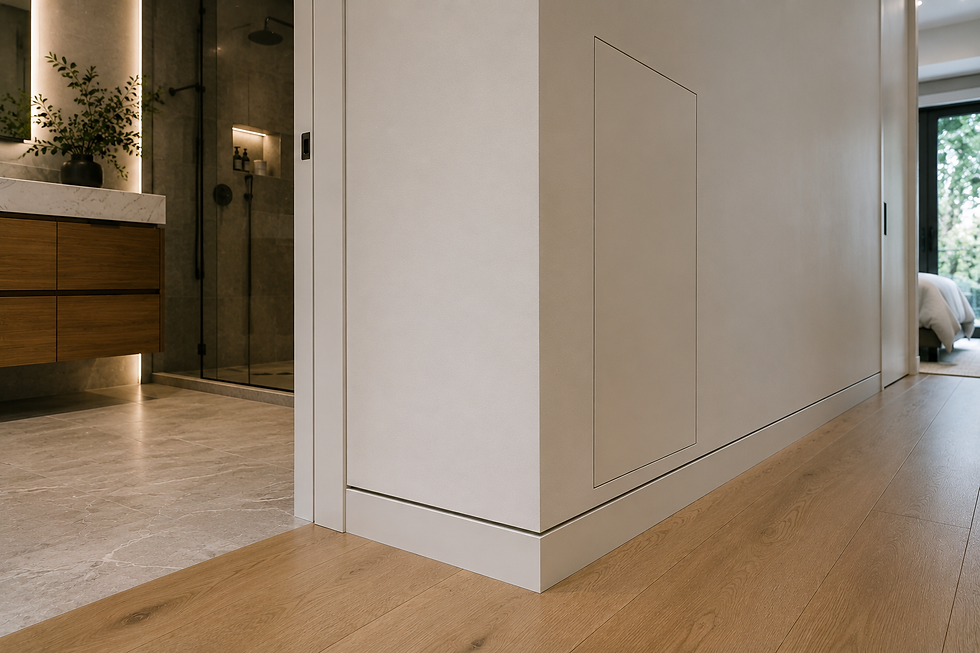
Factory-installed finishes can improve consistency.
But luxury finish work is judged at the final millimeter.
Not by the process.
Not by the manufacturing story.
By the finished result.
Transport, craning, setting, stitching, weather exposure, trade traffic, field adjustments, and final integration can all affect finish quality.
Potential issues include:
drywall cracking at module joints
uneven reveals
flooring transitions
trim misalignment
cabinet fit issues
stone damage
tile transition problems
paint touch-up inconsistencies
window and door adjustment issues
acoustic gaps
visible stitch lines
movement at module joints
concealed transport damage
This is where the homeowner stops caring how innovative the process was.
They care about what they can see, feel, hear, and live with.
What everyone at the table is thinking
The homeowner
“I do not want my home to feel assembled. I want it to feel crafted.”
That is the standard.
The architect
“Do the reveals align? Do the materials transition cleanly? Does the home feel intentional?”
Those are not minor questions in luxury work.
They are the work.
The structural engineer
“Movement and deflection still exist.”
Modules move during transport. Connections settle. Seismic design assumes movement. Foundations vary. If finish systems do not accommodate movement, the project can telegraph stress through the finishes.
The builder
“Who owns the final condition?”
That is where warranty and accountability matter.
If a finish is factory-installed but damaged during transport or set, who owns it?
If a joint moves after installation, who repairs it?
If a field trade must make a factory condition look seamless, who controls the tolerance?
The subcontractor
“Do not hand me an imperfect substrate and ask me to produce a perfect finish.”
That is the finishing trade’s nightmare.
The brutal truth
Luxury clients do not grade the factory process.
They grade the final millimeter.
For high-end homes, some finish work may be better left for controlled site installation, even if that reduces some factory efficiency.
The Accountability Problem: Who Owns the Leak?
Integrated off-site construction is often sold as a cleaner, more coordinated process.
It can be.
But only if accountability is clear.
If accountability is not clear, modular construction can create a blame triangle between the architect, manufacturer, builder, engineer, installer, and subcontractors.
That is unacceptable in luxury residential work.
The homeowner does not want to hear:
“That was the factory.”
“That was the site contractor.”
“That was the waterproofing sub.”
“That was the architect’s detail.”
“That was the installer.”
“That was a tolerance issue.”
“That happened during transport.”
The homeowner wants the issue fixed.
That means the team needs a responsibility matrix before fabrication begins.
Not during punch.
Not after the first warranty claim.
Before fabrication.
What everyone at the table is thinking
The homeowner
“I want one accountable team.”
Exactly.
A luxury client should not have to become a forensic claims manager.
The architect
“Design responsibility, fabrication responsibility, and construction responsibility cannot blur casually.”
Correct.
If the architect is deeply involved in selecting, coordinating, or presenting the off-site system, role clarity matters.
The structural engineer
“Connection responsibility must be explicit.”
If a connection fails or moves beyond expectation, was it design, fabrication, installation, tolerance, foundation, or field modification?
That needs to be defined early.
The builder
“Do not make me responsible for things I did not design, fabricate, transport, or control.”
That is a legitimate commercial concern.
A builder can own the outcome only if the builder has the authority, information, and contractual structure to manage the outcome.
The subcontractor
“Do not ask me to warranty a condition I did not design, approve, or control.”
Also fair.
The brutal truth
If responsibility is unclear, modular can become a faster way to create disputes.
Innovation without responsibility is not a delivery model.
It is risk transfer.
The Hybrid Future: Factory Precision, Field Discipline
Bur Oak is not anti-modular.
We are anti-uncritical modular.
Full turnkey modular may be the right answer for certain repeatable housing types, ADUs, multifamily projects, hospitality projects, simplified residential programs, and select rebuild scenarios.
But for high-end custom homes in Los Angeles, full turnkey modular should not be treated as the default answer.
The better future may be hybrid.
Use the factory where repetition, quality control, schedule compression, and controlled assemblies create value.
Use the field where the site, architecture, waterproofing, inspection access, serviceability, and luxury finish quality demand direct control.
That may mean using off-site fabrication for:
wall panels
floor cassettes
roof trusses
light-gauge steel assemblies
stair systems
MEP racks
utility walls
bathroom pods in select cases
envelope mockups
standardized fire-hardening details
shop-built millwork
repeatable framing components
while keeping direct field control over:
foundations
drainage
site waterproofing
high-risk transitions
exterior cladding interfaces
decks and balconies
pools and hardscape
final MEP tie-ins
luxury finish integration
inspections
punch list
warranty accountability
Hybrid is not a compromise.
Hybrid is scope discipline.
It asks each part of the project a simple question:
Where can this work be best controlled?
Sometimes the answer is the factory.
Sometimes it is the field.
The best projects will know the difference before they start.
The Bur Oak Test: 10 Questions Before Choosing Modular
Before committing to a full turnkey modular path, a serious project team should answer these questions.
1. What problem are we actually trying to solve?
Speed, cost certainty, fire resilience, labor control, quality control, client experience, scalability, or something else?
If the goal is unclear, the system choice will be unclear.
2. Is this project repeatable enough for full turnkey modular?
A highly repeatable design may benefit from deep factory integration.
A highly custom home may be better suited for selective off-site fabrication.
3. At what point does customization start fighting the system?
If every major client decision creates fabrication changes, the model may lose its advantage.
4. What must be fully resolved before fabrication begins?
Structure, MEP, windows, doors, finishes, appliances, waterproofing, utilities, site logistics, and owner selections need to be addressed early.
5. Who enforces the design freeze?
If no one can say “no” to late changes, turnkey modular can become expensive quickly.
6. How will foundation accuracy be verified?
Dimensions, elevations, embeds, anchors, hold-downs, bearing points, and utility stubs need formal verification before delivery.
7. How will waterproofing continuity be controlled?
The project needs clear details for every transition between factory-built and site-built work.
8. What inspections happen in the factory versus on site?
The team must define inspection responsibility before concealed work is covered.
9. Who owns the warranty at the interfaces?
The owner should not be stuck between the architect, manufacturer, builder, engineer, installer, and subcontractors.
10. Which parts of the project are better built off site, and which parts need to remain site-built?
This is the question that leads to a real hybrid strategy.
Final Thought
Modular construction may help Los Angeles build faster.
But faster is not the same as better.
Better means the design is resolved before fabrication. The site is ready before delivery. The foundation is verified before set. The control layers connect after installation. The MEP systems are serviceable. The finish work meets the standard. The owner knows who is accountable.
For high-end homes, the future is not modular for the sake of modular.
The future is disciplined integration.
Factory precision where repetition creates value.
Field discipline where the site, architecture, inspections, waterproofing, serviceability, and finish quality demand control.
The factory can improve the assembly.
The team still has to deliver the building.
That is the hybrid future Bur Oak believes is worth exploring.


Comments